
Do you ever watch your child swiping through a tablet and feel a twinge of guilt? You aren’t alone. In a world where screens are the default babysitter, many of us worry we’re letting something vital slip away.
We ask ourselves: Are they falling behind? Are they losing touch with the real world?
Technology is amazing. Apps and games can spark curiosity. But there is a growing sense that, while our kids are "connected" digitally, they are becoming physically disconnected. The truth is, children don't just learn with their eyes and ears. They learn with their hands, their bodies, and their messy, creative impulses.
Research backs up that gut feeling: tactile learning isn't just "nice to have." It is the foundation of how your child’s brain is wired.
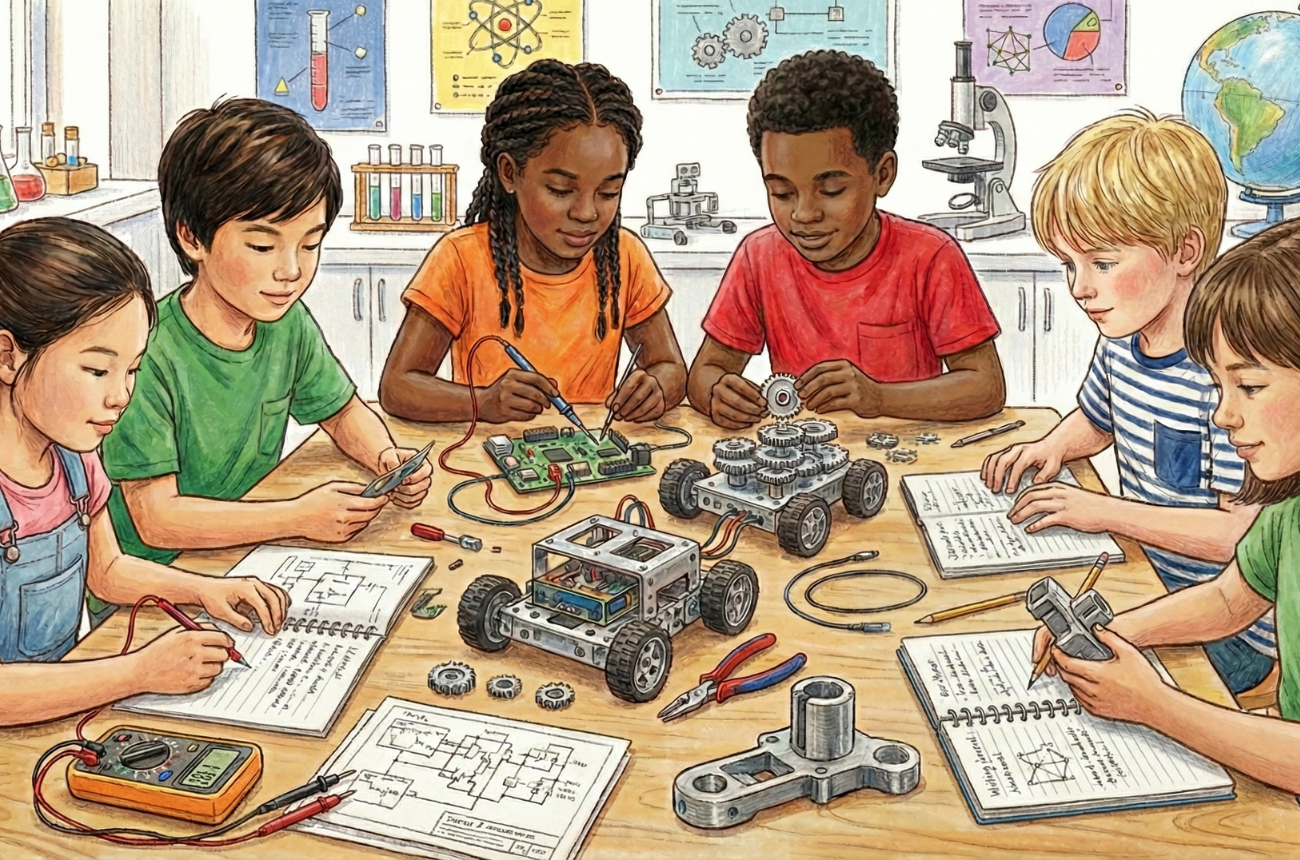
When a child manipulates clay, stacks blocks, or traces a letter on paper, they aren't just playing. They are building neural pathways. This "multi-sensory" engagement, feeling the resistance of a crayon or the rough texture of a puzzle piece, helps children retain information better than just seeing it on a screen [ABCmouse, n.d.].
There is a big difference between dragging a virtual block and balancing a real one. Tactile play fosters critical cognitive skills such as problem-solving and spatial awareness. Crucially, it builds fine motor skills—the muscle control needed to tie shoes, button shirts, and write legibly.
A recent study comparing high and low touchscreen usage in preschoolers found that children who spent significant time on screens had lower hand skill proficiency than those who didn't [Daud et al., 2020]. Put simply: swiping doesn't build the dexterity that grasping does.
Screens are solitary. Even "social" games often isolate kids in their own bubbles. Real-world play, however, forces interaction. It requires negotiation ("pass me the blue one") and collaboration. Research observing children in museums found that when screens were present, the quality of social interaction dropped compared to screen-free play [Li et al., 2022].
It’s easy to feel overwhelmed by the pressure to "keep up." We worry that if our kids aren't tech-savvy, they'll be left behind. But the real risk might be the opposite.
Heavy reliance on screens can displace the activities that build resilience and emotional grounding. If a child never physically grapples with a puzzle that won't fit, do they learn to push through frustration? If they don't engage in messy, open-ended play, do they learn to trust their own creative instincts?
We know you want your child to feel confident and capable. You want them to know the difference between right and wrong, and to trust their own judgment. But teaching these abstract concepts can feel impossible when you're competing with a flashy iPad.
This is where the Ivy and Kem Activity Book steps in.
Designed for children ages 6 to 11, a critical window for developing self-awareness, this is not just a coloring book. It’s a bridge between ancient wisdom and hands-on fun. It takes the Seven Universal Principles (big ideas about cause and effect, vibration, and rhythm) and translates them into tangible activities.
Here is how it turns screen-free time into a life lesson:
It is a tool that can help that nagging parental fear of “Am I doing enough?” by giving you a simple, practical tool to spark deep conversations and build emotional resilience, all without a charger.
You don't need to ban tablets forever. You just need to be intentional. Here is how to start:
Your child is wired to explore the world with their hands, not just their thumbs. In a digital world, tactile experiences are the anchor they need to feel grounded, capable, and creative.
You have the power to give them that foundation. Whether it’s through a simple box of crayons or the guided adventures in the Ivy and Kem Activity Book, every hands-on moment is a step toward a more confident, resilient child.
Ready to help your child disconnect to reconnect? Grab your copy of the Ivy and Kem Activity Book here and start building those real-world connections today.
And check out Ivy and Kem & the Seven Universal Principles by Rhea Welch.
References:
© 2021-2026 Between the Lions Services. All Rights Reserved. Website crafted by Between the Lions Services.
Hit Go to Search or X to close